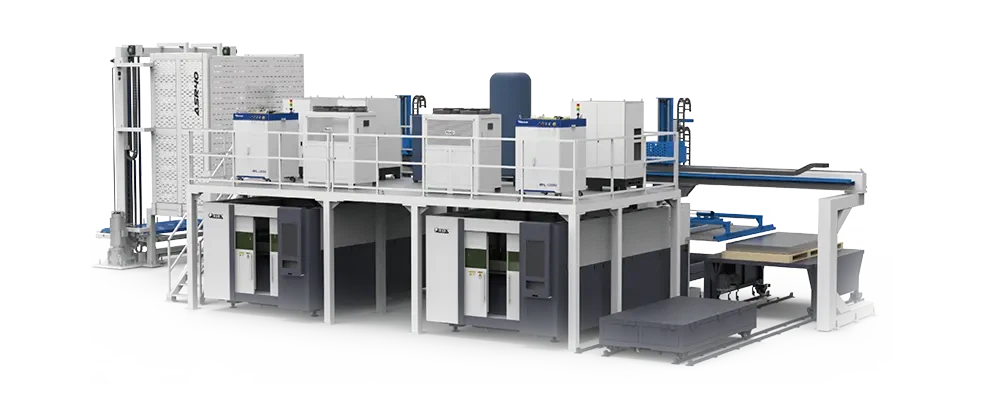
In the complex landscape of modern industrial operations, the efficient handling of material storage in a multi – level environment stands as a critical challenge. As a seasoned provider of Material Storage and Automatic Loading/Unloading Systems, I’ve witnessed firsthand the transformative impact of well – designed systems on businesses. In this blog, I’ll delve into how our systems tackle the intricacies of multi – level material storage. Material Storage and Automatic Loading/Unloading System
Understanding the Multi – Level Environment
A multi – level environment in material storage can take various forms. It could be a multi – story warehouse, a high – bay storage facility with multiple tiers, or a complex manufacturing setup where different levels are used for different stages of production or storage. Each level may have unique requirements in terms of accessibility, storage density, and throughput.
One of the primary challenges in a multi – level environment is the efficient movement of materials between levels. Traditional manual methods are often time – consuming, error – prone, and limited in terms of capacity. Additionally, the space utilization on each level needs to be optimized to make the most of the available vertical real estate.
Our Approach to Material Storage in Multi – Level Environments
1. Vertical Conveyor Systems
At the heart of our solution for multi – level material movement is the implementation of vertical conveyor systems. These conveyors are designed to transport materials quickly and safely between different levels. We offer a variety of conveyor types, including continuous – loop vertical conveyors and reciprocating vertical conveyors.
Continuous – loop vertical conveyors are ideal for high – volume, continuous material flow. They operate in a loop, constantly moving materials up or down, and can handle a large number of items per hour. This makes them suitable for applications where materials need to be transferred rapidly between multiple levels, such as in large – scale e – commerce fulfillment centers.
Reciprocating vertical conveyors, on the other hand, are more suitable for applications where materials need to be transported in batches or at irregular intervals. They move up and down in a linear motion, and can be customized to handle different load sizes and weights. This type of conveyor is often used in manufacturing plants where materials need to be transferred between different production levels.
2. Automated Storage and Retrieval Systems (AS/RS)
Our Automated Storage and Retrieval Systems play a crucial role in optimizing material storage in a multi – level environment. AS/RS are highly automated systems that use cranes, shuttles, and other equipment to store and retrieve materials from storage locations.
In a multi – level setting, AS/RS can be configured to operate on multiple levels simultaneously. This allows for high – density storage, as materials can be stored vertically in narrow aisles. The automated nature of the system also eliminates the need for manual labor in the storage and retrieval process, reducing the risk of errors and improving overall efficiency.
We can customize AS/RS to fit the specific requirements of each customer. For example, in a multi – story warehouse, we can design the system to have different storage zones on each level, based on factors such as material type, frequency of access, and storage volume.
3. Warehouse Management Systems (WMS)
A sophisticated Warehouse Management System is essential for coordinating the movement of materials in a multi – level environment. Our WMS provides real – time visibility into the location of materials, inventory levels, and the status of storage and retrieval operations.
The WMS can optimize the storage of materials on different levels by using algorithms to determine the most efficient storage locations. For example, it can group similar materials together on the same level or zone, reducing the time required for retrieval. It can also prioritize the movement of materials based on factors such as production schedules or customer orders.
In addition, the WMS can integrate with other systems in the production or distribution process, such as enterprise resource planning (ERP) systems and transportation management systems (TMS). This seamless integration ensures that materials are moved in a coordinated manner, from the point of storage to the point of use or shipment.
Benefits of Our Multi – Level Material Storage Solutions
1. Increased Space Utilization
By using vertical conveyor systems and AS/RS, our solutions can significantly increase the space utilization in a multi – level environment. This is especially important in areas where land is scarce and expensive. Our systems can store materials in a more compact manner, allowing businesses to make the most of their available vertical space.
2. Improved Efficiency
The automated nature of our systems reduces the time and labor required for material storage and retrieval. The vertical conveyor systems can move materials between levels quickly, while the AS/RS can retrieve materials from storage locations in a matter of seconds. The WMS further enhances efficiency by optimizing the storage and movement of materials, reducing the need for manual intervention.
3. Enhanced Accuracy
Manual material handling is prone to errors, such as misplacement of materials or incorrect order picking. Our automated systems, on the other hand, are highly accurate. The AS/RS uses precise positioning technology to ensure that materials are stored and retrieved from the correct locations, while the WMS tracks the movement of materials in real – time, minimizing the risk of errors.
4. Scalability
Our multi – level material storage solutions are designed to be scalable. As businesses grow and their storage requirements change, our systems can be easily expanded or modified. For example, additional conveyor lines can be added to increase the throughput between levels, or the AS/RS can be reconfigured to accommodate more materials.
Real – World Applications
One of our customers, an automotive manufacturer, had a multi – story manufacturing plant where different levels were used for the storage of raw materials, work – in – progress, and finished products. The company was facing challenges in moving materials between levels efficiently, resulting in delays in production and increased costs.
We implemented a combination of vertical conveyor systems, AS/RS, and a WMS for the customer. The vertical conveyor systems were used to transport materials between different levels, while the AS/RS was used to store and retrieve materials in a high – density manner. The WMS coordinated the movement of materials, ensuring that the right materials were available at the right time.
As a result, the customer was able to reduce the time required for material movement between levels by 50%, improve the space utilization in the plant by 30%, and increase the overall production efficiency by 20%.
Conclusion
In conclusion, our Material Storage and Automatic Loading/Unloading Systems offer a comprehensive solution for handling material storage in a multi – level environment. Through the use of vertical conveyor systems, AS/RS, and WMS, we can help businesses optimize their space utilization, improve efficiency, enhance accuracy, and scale their operations as needed.
Material Storage and Automatic Loading/Unloading System If you’re facing challenges in managing material storage in a multi – level environment, I encourage you to reach out to us for a consultation. Our team of experts can assess your specific requirements and design a customized solution that meets your needs. Let’s work together to take your material storage and handling processes to the next level.
References
- Tompkins, J. A., White, J. A., Bozer, Y. A., & Tanchoco, J. M. A. (2010). Facilities Planning. John Wiley & Sons.
- Gu, J., Goetschalckx, M., & McGinnis, L. F. (2007). Research on warehouse operation: A comprehensive review. European Journal of Operational Research, 177(1), 1 – 21.
- Boysen, N., Fliedner, M., & Schmid, S. (2009). Warehouse design and control: Framework and literature review. European Journal of Operational Research, 194(3), 623 – 645.
Suzhou Quick Laser Technology Co., Ltd.
Suzhou Quick Laser Technology Co., Ltd. is one of the most professional material storage and automatic loading/unloading system manufacturers and suppliers in China, featured by quality products and good price. Please feel free to buy durable material storage and automatic loading/unloading system for sale here from our factory. For more information, contact us now.
Address: No. 6, Qingqiu Street, Industrial Park, Suzhou, Jiangsu Province, China
E-mail: info@qlteklaser.com
WebSite: https://www.qlteklaser.com/
