As the owner and operations lead at a global EPS pre-expander manufacturing facility, I’ve spent 12 years on the floor—troubleshooting 2 a.m. production line breakdowns, training new operators, and walking with plant managers from food packaging plants to insulation manufacturers, all asking the same question: “What pressure do I need for my EPS pre-expander?” It’s not a one-size-fits-all number, and I’ve seen too many companies burn through resin, waste energy, and miss delivery targets because they guessed wrong. Today, I’m breaking down what pressure really means for your pre-expander, why it’s non-negotiable for consistent EPS, and how to nail the right setting for your specific run. EPS Pre-expander
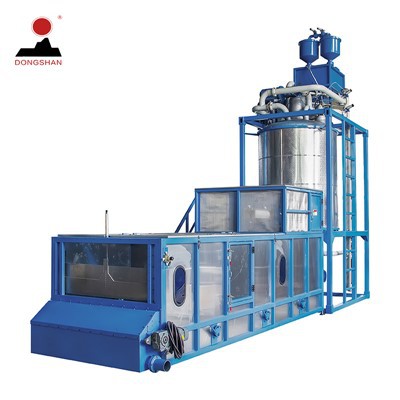
First, let’s ground this in what EPS pre-expansion actually does, because pressure doesn’t exist in a vacuum. Expandable polystyrene (EPS) starts as tiny, solid resin beads pre-impregnated with pentane, a lightweight hydrocarbon blowing agent. When you heat those beads to roughly 80–120°C (175–250°F), the pentane vaporizes, turns from a liquid to gas, and pushes the polystyrene chains apart, turning tiny beads into soft, puffy spheres 10–50 times their original size. The pre-expander’s job is to control that heating and pressure to get beads with uniform size, density, and expansion ratio—those three factors will make or break your final product, whether that’s disposable coffee cups, packaging for delicate electronics, or residential building insulation.
Now, pressure is the unsung control knob here. Think of it as the “gatekeeper” for that pentane vapor. When you heat the beads, the pentane inside wants to expand, but if the pre-expander’s internal pressure is too high, it traps the vapor inside the bead’s polymer shell, limiting how much the bead can puff up. If pressure is too low, the pentane vapor escapes too quickly before the polymer can stretch, leading to under-expanded, brittle beads that won’t bind properly when molded. That’s a frustrating tradeoff I’ve watched countless operators battle, and it’s why getting pressure right is foundational.
Let’s get into the specific pressure ranges, because this is where most new customers get confused. We design and manufacture two primary types of pre-expanders: atmospheric and pressurized, and the pressure requirements are night and day. Atmospheric pre-expanders operate at 0 bar gauge (0 psi, or equal to atmospheric pressure around you at sea level). These are for low-density EPS (10–20 kg/m³), like the light beads used for flower pot drainage or packing peanuts. For atmospheric units, you’re not adjusting a high-pressure regulator—you’re controlling temperature and residence time, and pressure is effectively ambient. But atmospheric pre-expanders have a big limit: they can’t produce higher-density, more durable EPS because there’s no pressure to keep pentane locked in while the polymer expands.
That’s where pressurized pre-expanders come in, and this is where the actual pressure numbers matter. For most industrial applications—think medium-density packaging (20–50 kg/m³), insulation for wall panels, or protective packaging for appliances—we recommend a pressure range of 0.5–1.5 bar gauge (7–22 psi). Wait, I know that feels low compared to what you might associate with industrial equipment, but I’ve tested this with our own equipment: run a pressurized pre-expander at 0.3 bar, and your beads will be 10–15% under-expanded with a high amount of “fines” (tiny, broken beads that get swept into your exhaust and clog filters). Run it at 1.8 bar, and you’ll waste 8–12% more resin, because the beads are over-expanded, too soft, and will crumble during molding.
But here’s the key point I always hammer home to customers: these ranges are not universal. They shift based on three variables no two production runs share: resin type, desired density, and pre-expander model. Let’s break each down, because skipping this step is how you end up with bad product and wasted time.
First, resin type. Not all EPS beads are the same. Some are standard general-purpose (GP) beads for packaging, some are flame-retardant (FR) beads for construction, some are high-impact (HI) beads for heavy-duty packaging, and even the same resin from different suppliers can have slightly different pentane loadings and polymer molecular weights. For example, FR beads have additives that change how the polymer responds to heat and pressure. Last year, a customer making fire-resistant insulation came to us saying their pre-expander was producing beads that failed flame tests. We checked their pressure: they were using 1.2 bar, but FR beads require 0.8–1.0 bar. The higher pressure was compressing the flame-retardant additives into the polymer shell, so when they molded the blocks, the additives weren’t distributed evenly. Adjusting pressure to 0.9 bar fixed the flame test on the first test run, and they’ve been a repeat customer ever since. Another example: high-impact beads need a slightly higher pressure (1.0–1.5 bar) because their thicker polymer walls require more pressure to keep pentane inside long enough to expand evenly. Too low pressure, and the beads are prone to cracking, which ruins their impact resistance.
Second, desired density. Density is the biggest driver of pressure, because density is inversely related to expansion ratio. A 10 kg/m³ EPS block is the lightest common type, requiring the lowest pressure (0.4–0.7 bar), because you want maximum expansion, with minimal density. A 50 kg/m³ block is much denser, so it needs higher pressure (1.0–1.5 bar) to limit expansion and keep the beads tightly packed. I had a customer last quarter who was switching from making light packing peanuts (15 kg/m³) to protective packaging for wine bottles (35 kg/m³). They tried keeping their pressure the same (0.6 bar) and ended up with beads that were too large and soft, so the packaging didn’t hold its shape during shipping. Cranking pressure up to 1.1 bar brought their density to 36 kg/m³, exactly what they needed, and they reduced their breakage rate by 22% in the first month.
Third, pre-expander model and design. Not all pre-expanders are built the same. Some are batch-type (for small runs, custom products) and some are continuous-type (for high-volume production, like 24/7 packaging plants). Our continuous pre-expanders, for example, have a pressurized mixing chamber where beads are heated, mixed, and expanded, so pressure is consistent across the entire run—ideal for high-volume, low-variety production. Our batch pre-expanders, on the other hand, have a pressurized vessel that seals and heats beads, so pressure is applied in a controlled ramp: start at 0.5 bar, hold for 5 minutes, ramp up to 1.2 bar for the last 2 minutes of expansion, then release pressure gradually. For batch units, the average pressure is similar to continuous, but the ramp is what matters for uniform expansion, which is why we include a pressure ramp controller as standard equipment on all our batch pre-expanders. I’ve seen customers with our competitors’ batch units skip the ramp and run at a steady 1.0 bar, resulting in beads that are under-expanded on the inside and over-expanded on the outside, leading to inconsistent molding.
Now, let’s talk about the mistake I see most new operators making: relying on generic pressure numbers from a resin supplier or a random internet post. Resin data sheets will list a “recommended pressure range” that’s a baseline, but that’s for ideal conditions in a lab, not for a production line running 12 hours a day with different inlet air temperatures or resin batches. For example, if your plant is in a hot, humid climate, the incoming resin beads have higher moisture content, which can lower the effective pressure in the pre-expander’s chamber by 0.1–0.2 bar. Last summer, a customer in Florida called us panicked because their production line was running 5% below target density. We walked through their line and found they were using the standard 1.0 bar pressure, but the high humidity had increased moisture in the beads, so we adjusted pressure to 1.1 bar, and they hit their density target that same shift.
Another common error: not calibrating pressure gauges. I can’t stress this enough—pressure gauges on pre-expanders drift over time, especially if they’re exposed to high temperatures and vibration. I recommend calibrating your pre-expander’s pressure gauge every 3 months, and keeping a log of each run’s pressure, density, and final product quality. That log will help you spot trends: if every time you run resin from Supplier B, you need to add 0.1 bar to hit your target density, that’s a trend you can lock in, instead of guessing each time.
What about safety? I know when people hear “pressurized equipment,” they get nervous, and rightfully so. All our pressurized pre-expanders are built with ASME certification, pressure relief valves, and interlock systems that shut down the unit if pressure exceeds the maximum safe limit. The pressure ranges I mentioned earlier are well below the maximum rated pressure of our units, so as long as you follow manufacturer maintenance guidelines, safety is not a concern. The key is to never modify the pressure settings without checking with your pre-expander supplier—cranking pressure too high can not only ruin your product, it can strain the heating system and lead to premature wear on your unit’s mixing chamber.
Now, how do you find the exact pressure for your run? Let’s walk through a simple step-by-step process I give all new customers, because this eliminates guesswork. First, start with the resin supplier’s recommended baseline pressure, adjusting for local humidity and climate (add 0.1 bar for hot, humid areas, subtract 0.1 bar for cold, dry areas). Second, run a small test batch: 5–10 kg of resin, operating at that baseline pressure, and measure the density of the resulting beads. Third, if your density is too low (beads are too puffy), increase pressure by 0.1 bar and test again. If your density is too high, decrease pressure by 0.1 bar. Fourth, once you hit your target density, test the beads for uniformity: sift them with a size grader, and aim for 90% of beads within 0.5 mm of your target size. If too many beads are too small (fines), your pressure is too low; if too many are too large, pressure is too high. This test takes about 30 minutes, and it will save you days of wasted production runs down the line.
Over the years, I’ve had customers come to us after switching to cheaper pre-expanders from overseas, and they’re shocked at how much easier it is to get consistent EPS with our units, especially when it comes to pressure control. One customer in the automotive parts industry told me their old pre-expander’s pressure gauge was off by 0.3 bar, so they were wasting 15% of their resin every month on bad beads. After installing our pre-expander and calibrating the pressure, they cut resin waste by 12% in the first quarter, saving nearly $20,000 a year on materials. That’s the value of getting pressure right—it’s not just about product quality, it’s about your bottom line.
If you’re currently struggling with inconsistent EPS quality, high resin waste, or production delays from pre-expander issues, we can help you dial in the exact pressure requirements for your specific application. We offer custom pressure testing, on-site pre-expander audits, and operator training to make sure you get the most out of your equipment. There’s no one-size-fits-all pressure, but with the right data and equipment, you can get consistent, high-quality EPS every run. Reach out to us to discuss your pre-expander needs, and let’s work together to optimize your production process.
EPS Block Molding Machine References:
- Shaffer, J. L. (2002). Expanded Polystyrene Technology and Applications. CRC Press.
- European Plastics Converters Association. (2018). Best Practice Guidelines for EPS Pre-Expansion and Molding. EuPC Publications.
- American Society of Mechanical Engineers. (2021). Pressure Equipment Safety Standards for Polymer Processing. ASME International.
- Gomez, M., & Patel, R. (2019). Effect of Process Parameters on EPS Bead Uniformity. Journal of Polymer Processing Engineering, 37(4), 412–427.
Hangzhou Fuyang Dongshan Plastic Machinery Co., Ltd.
Hangzhou Fuyang Dongshan Plastic Machinery Co., Ltd. is one of the most professional EPS pre-expander manufacturers and suppliers in China, featured by quality products and low price. Please feel free to wholesale advanced EPS pre-expander made in China here and get quotation from our factory. Customized orders are welcome.
Address: 101 Guanting, Baiqian Villige, Luzhu Town, Fuyang District, Hangzhou City, Zhejiang Province, China
E-mail: xu@dong-shan.cn
WebSite: https://www.epseppmachinery.com/
