When I first started my journey as a PP woven cloth supplier, I didn’t fully appreciate the complexity hidden behind what looks like a simple, durable fabric. I’d seen the final rolls stacked in our warehouse—thick, tightly wound, ready to become fertilizer bags, construction tarps, or bulk packaging for agricultural goods—but I had no idea how much precision goes into every step of production. Over the past fifteen years, I’ve walked every station on our factory floor, from raw material unloading to quality control checks, and I’ve learned that each stage is critical to the cloth’s strength, weight, and intended use. Today, I want to take you through that process, straight from the perspective of someone who’s lived this work every day. PP Woven Cloth
The Foundation: Choosing the Right Polypropylene Resin
It all starts with raw material selection, and this is where we don’t cut corners. Polypropylene (PP) resin is the base, and not all resin is equal. For our PP woven cloth, we use virgin polypropylene resin, not recycled material, because recycled resin can have inconsistent molecular structure that leads to weaker, less uniform cloth. Think of it like baking bread: if you use old, lumpy flour instead of fresh, fine flour, your end product will turn out uneven and crumbly. We source our resin from trusted suppliers that deliver small, uniform pellets—usually light gray or off-white in color—with a specific melt flow rate (MFR) between 10 and 15 g/10min. This MFR is key: it tells us how easily the resin melts, and a rate in that range ensures we can extrude consistent strands without them breaking or becoming too thin.
Before the resin even enters the extruder, our factory technicians do a quick quality check. We take a sample of pellets, melt a small amount, and test its tensile strength. If it doesn’t meet our standard, we send it right back. For specialty PP woven cloth that needs extra UV resistance—like the tarps used in construction or outdoor agriculture—we add small amounts of UV stabilizer masterbatch to the resin. This is a tiny additive, usually making up 2-3% of the total mix, but it’s what keeps the cloth from turning brittle and cracking after months in the sun. I’ve seen too many competitors skip this step to save money, only to have their cloth tear after a single season. That’s a mistake we never make.
Extruding the Film: Turning Pellets into Flat Sheets
The next step is extrusion, where the solid resin pellets turn into a thin, flat film. This happens in a large extruder machine—a steel barrel with a rotating screw inside that heats and pushes the resin forward. The heating process is precise: we control the temperature in zones along the barrel, starting at around 200°C at the feed hopper (where pellets go in) and rising to 250°C at the die, the flat opening at the end of the extruder. Too low, and the resin doesn’t melt fully, leading to lumps in the film. Too high, and the resin degrades, making the cloth weak.
As the melted resin exits the die, it’s a wide, thin sheet—usually between 0.5 and 1 millimeter thick. We call this “casting” the film, and after it exits the die, we cool it quickly by pulling it over a series of chilled steel rollers. Rapid cooling keeps the film’s molecules aligned the way we want, which makes the final woven cloth stronger. If we cooled it slowly, the molecules would tangle loosely, leading to a flimsy fabric. This step is where we first see the film’s uniformity: our technicians walk along the roller line, measuring the film’s thickness every few meters with a micrometer. Any spot that’s too thick or too thin gets flagged, and the machine adjusts automatically to fix it.
Once cooled, the flat film is folded in half lengthwise, like folding a bed sheet, and fed into a slitting machine. The slitting machine cuts the folded film into narrow strips—usually 2 to 5 millimeters wide, depending on the final cloth’s desired strength and texture. These strips are called “tapes,” and they’re the building blocks of our woven cloth. Right after slitting, the tapes go through a stretching machine, a step that’s often called “orienting” the tapes. We heat the tapes gently to around 100°C and stretch them three to five times their original length. This stretches the molecules along the tape’s length, making the tapes much stronger and more rigid. It’s like stretching a rubber band: once you stretch it out, it’s thinner and much harder to break.
Weaving: Turning Tapes into Woven Cloth
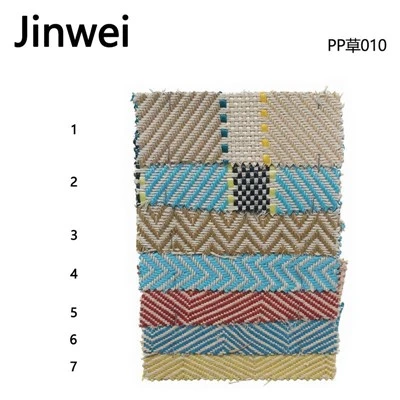
With strong, uniform tapes ready, it’s time to weave them into the final fabric. We use flat loom machines—specifically, circular looms for most of our PP woven cloth, because circular looms weave multiple tapes at once for high volume. The process is similar to weaving a basket, but on a massive scale. There are two sets of tapes: warp tapes, which run lengthwise, and weft tapes, which run crosswise, over and under the warp tapes.
Our looms run at a steady pace—usually around 80 to 120 picks (crosswise tapes) per minute, depending on the cloth’s weight. Thicker, heavier cloth (like heavy-duty bags for grain) uses slower speeds to ensure the tapes are woven tightly, while lighter cloth (like lightweight tarps) can run faster without sacrificing quality. One thing I’ve learned over the years is that loom tension is everything. If the warp tapes are too loose, the woven cloth will be wrinkled and weak. If they’re too tight, the tapes will snap mid-weave, wasting material and slowing production. Our loom operators check tension every hour, adjusting settings as needed—even small changes in humidity or resin temperature can affect tension, so we can’t set it and forget it.
During weaving, we also add any special features the customer orders. For example, if a customer needs a bag that can hold 50 pounds of fertilizer, we might weave an extra layer of thick tapes in the bottom section for reinforcement. If a customer wants the cloth printed with their brand logo, we add flexographic or rotogravure printers to the loom line, printing directly onto the woven fabric as it comes off the loom. I’ve had customers tell me they were worried printing would damage the cloth, but when we test it, the ink bonds to the PP surface perfectly, and the cloth’s strength stays intact.
Finishing and Quality Control: Making It Ready for Use
Once the woven cloth comes off the loom, it goes through a series of finishing steps to make it usable and consistent. First, it’s wound onto large rolls, usually 1 to 2 meters in diameter, depending on the customer’s order size. Then, we cut the rolls into the exact width and length the customer needs—whether that’s a 1-meter-wide strip for small bags or a 10-meter-wide tarp for construction sites. We also treat the cloth if it needs to be water-resistant or heat-sealable. For water resistance, we coat the cloth with a thin layer of low-density polyethylene (LDPE) extrusion, which creates a barrier that keeps water out without adding too much weight. For heat-sealable bags, we add a special coating to the edges so customers can seal the bags with a heat press without them coming apart.
Quality control is non-negotiable for us, and we have three checks at different stages of production. First, during extrusion, we test the film’s tensile strength and thickness. Second, during weaving, we check for broken tapes, misaligned crosswise threads, and tension issues. Third, after finishing, we test every roll for water resistance (if required), UV protection (if required), and overall strength. We use a tensile tester to pull a small sample of cloth until it breaks, measuring how much force it takes to do so—for heavy-duty bags, we require a minimum of 2000 Newtons of force, meaning it can hold 50 pounds easily. If a roll doesn’t pass these tests, we don’t ship it. We’ve had to scrap whole rolls before, and it’s not cheap, but it’s worth it to keep our customers’ trust.
Why Our PP Woven Cloth Stands Out
I know there are a lot of PP woven cloth suppliers out there, but what sets us apart is that we control every step of the production process in-house. Some suppliers outsource parts of the process to cut costs, but that can lead to inconsistent quality. We source our resin, run our own extruders and looms, and do all our quality checks on site. That means we can adjust to customer needs quickly—if a customer needs a special weight or a specific print, we don’t have to wait for a third party to make changes. We also offer customization options that many suppliers don’t: from UV stabilization and water resistance to custom sizes and prints, we can tailor the cloth to whatever the customer’s project requires.
Over the years, our customers have ranged from small farmers who need 100 fertilizer bags to large construction companies that need thousands of square meters of tarps. I’ve heard so many times from customers that our cloth lasts longer than what they used to buy from other suppliers. That’s not just luck—it’s the result of every step we take, from choosing the right resin to checking every roll before it leaves our factory.
Ready to Work Together?
If you’re in the market for reliable, high-quality PP woven cloth—whether for packaging, agriculture, construction, or any other use—I’m here to help. We can walk through your specific needs, whether that’s a certain weight, size, or special feature, and provide a quote that fits your budget. I’ve been in this industry long enough to know that the right supplier isn’t just someone who sells cloth—it’s someone who understands the process, stands behind their product, and is willing to work with you to get exactly what you need. Don’t hesitate to reach out to our team to start a conversation about your project. We’re ready to bring our years of experience to work for you.
References
PP Woven Fabric Polypropylene: Properties and Applications. Modern Plastics Encyclopedia, 2022.
Flat Woven Polypropylene Fabric Manufacturing Guide. International Code Council, 2021.
UV Stabilization for Polyethylene and Polypropylene Films. Journal of Applied Polymer Science, vol. 138, no. 24, 2021.
Nanping Kingway New Material Co., Ltd.
As one of the most professional pp woven cloth manufacturers and suppliers in China, we also support customized service. With abundant experience, we warmly welcome you to wholesale durable pp woven cloth in stock here from our factory. If you have any enquiry about pricelist, please feel free to email us.
Address: No. 10, Chengnan Branch Road, Chengjiao Town, Nanping, Fujian, China.
E-mail: npjwxcl@aliyun.com
WebSite: https://www.suernew.com/
